Couples therapy
Couples therapy when one or both of you is neurodivergent
I work with couples where ADHD, autism, or both are in the room, whether or not anyone has said so out loud. Start with a 30-minute intro for £60, in person in Fareham, Hampshire or online. If you go ahead, the £60 comes off your assessment.
Book a couples intro
The same argument, in different costumes
You've had this fight about the dishwasher. And about the birthday card. And about the thing that was said in the car in 2019. On the surface they're different arguments. Underneath, they're one argument in different outfits.
Most couples arrive able to describe the pattern in forensic detail and completely unable to stop it. That's not a failure of insight. Insight was never the missing piece.
What's usually happening
When one or both partners are neurodivergent, a great deal of conflict turns out to be translation failure rather than indifference. Two people are running different operating systems, each assuming the other has the same manual, each reading the other's behaviour through their own instruction set.
One partner experiences a delayed reply as neutral. The other experiences it as abandonment. Neither is misreading their own experience. They're misreading each other's, and then defending the misreading, because it feels like a fact.
What that produces, over years: a demand-avoidant partner who shuts down at the sound of a request, and a partner who has learned that the only thing that gets a response is escalation. Both of them exhausted. Both of them convinced they're the one who's tried hardest.
How it works
1. A 30-minute intro · £60
In person in Fareham, or online. We meet, you tell me what's going on, and we all get a sense of whether this is the right room. If you go ahead, the £60 is taken off the assessment.
2. The assessment · £399
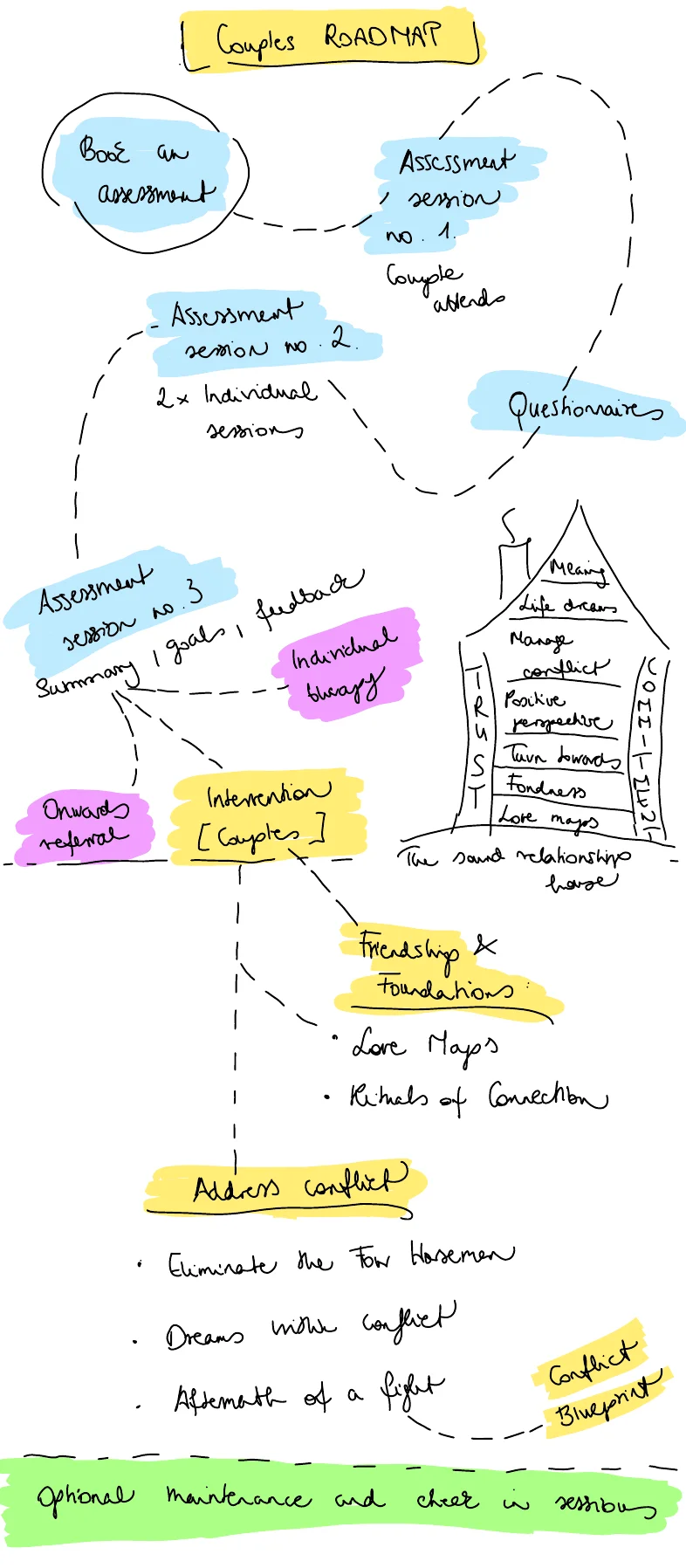
Three steps, so we understand the relationship before trying to change it.
- Session one, together (90 minutes). The relationship as you both see it.
- A questionnaire each, completed between sessions.
- Session two, individually (45 minutes each). Each of you gets space to speak on your own.
- Session three, together (90 minutes). I share what I've seen, we agree goals, and you get my honest feedback on what would help.
After session three, there are three possible routes: couples work together, individual therapy for one of you, or a referral to someone better placed to help. That's a real choice, not a sales funnel.
3. Couples sessions · £150 each, or three for £399
90-minute sessions, in person or online. The work draws on the Gottman method in two broad phases:
- Friendship and foundations: knowing each other's inner world again (love maps), and building small, reliable rituals of connection.
- Addressing conflict: replacing the four patterns that predict breakdown (criticism, contempt, defensiveness and stonewalling), finding the dreams hidden inside gridlocked arguments, and learning to recover after a fight. By the end you have your own conflict blueprint.
4. Optional check-ins
Maintenance sessions once things are steadier, if and when you want them.
What we actually do in the room
I'm trained through the Gottman Institute, and the Gottman method is the most rigorously researched approach to couples work there is. I adapt it, because the standard protocol makes assumptions about eye contact, processing speed, emotional vocabulary and conflict tolerance that don't hold for every nervous system.
In practice that means:
- We find out how each of you actually processes, not how you're supposed to. Some people need to leave the room to think. That's a legitimate need, not a rejection.
- We build repair that works for you both, rather than the version in the book. Repair that requires sustained eye contact and fluent emotional language will fail for at least one of you.
- We separate the neurology from the character. "You didn't do the thing" and "you don't care about me" are different sentences. Most couples have stopped being able to tell them apart.
- We stop trying to make either of you normal. There is no version of this where one of you gets fixed and the relationship works.
You don't need a diagnosis to come
Plenty of couples arrive with one formal diagnosis, one strong suspicion, and a lot of unspoken resentment about the asymmetry. Some arrive with no diagnosis at all and a growing sense that something structural is going on. All of that is workable. The assessment looks at the relationship, not at either of you. I don't diagnose ADHD or autism.
Is this a good fit?
This is likely a fit if:
- You keep having the same argument in different clothes.
- One of you is diagnosed, or fairly sure, and it's changed how you both understand the last ten years.
- Ordinary couples therapy hasn't worked, or made one of you feel like the defendant.
- You want to understand the mechanism, not be handed communication scripts.
This probably isn't a fit if:
- You're looking for someone to confirm which of you is the problem.
- You want a formal ADHD or autism assessment. That's a different service, and I'm happy to point you towards one.
- There's abuse or coercive control in the relationship. Couples work isn't safe in that situation, and I'll help you find what is.
- One of you has been brought here and doesn't want to be.
Questions
What's the first step?
A 30-minute intro, £60, in person in Fareham or online. If you decide to go ahead, the £60 comes off the £399 assessment.
Do we both need a diagnosis?
No. Self-identification is enough, and many couples come with one diagnosis and one suspicion.
Will you take sides?
No. If a session ever starts to feel like a tribunal, tell me and we'll change how we're working.
Why do we each have an individual session?
It gives each of you space to say things that are hard to say with your partner in the room. It's part of the assessment, not a separate course of therapy.
Can we do this online?
Yes. The intro, the assessment and the couples sessions can all be in person in Fareham or online.
What happens after the assessment?
In the third session I share what I've seen and we agree goals. From there it's couples sessions, individual therapy for one of you, or a referral elsewhere if that would serve you better.
How much does it cost?
The intro is £60, taken off the assessment if you go ahead. The assessment is £399 for three sessions. Couples sessions after that are 90 minutes, £150 each, or three for £399.
What if one of us is much more reluctant?
That's common, and it's usually information rather than an obstacle. Reluctance often means someone expects to be blamed. We'd address that at the start rather than working around it.